Orange Peels and Mirrors
Happy Sunday and first day of Black History Month 2026! Last year, I opened up February’s Undoing Toxic Blog with “You Nuh Live No Weh?” (click to read) reflecting on love, culture, and what it meant to grow up hearing phrases that shaped how we understood home, belonging, and accountability. This year, I am writing from a different place. This month continues the love and culture theme…but differently. This time the focus is not just reflection; it is discernment. I pose this important question to you: When it comes to lessons on love and culture, what do we keep? What do we return? And what do we finally stop carrying?
February has always been a month that holds both grief and expectancy. We honor Black history, recount ancestral suffering, uplift excellence, attend performances, listen to the same quotes, and carry the same hopes forward. And then, often, we move on back to a world that still struggles to see us fully.
One year later, the tone is different again. Black History Month does not feel quieter because it matters less. It feels heavier because pretending is harder. The sociopolitical climate has stripped away some of the performative language and left us face-to-face with unfinished work. The songs of hope still exist, but they sit alongside fatigue, vigilance, and a clearer understanding of how slow change really is. Love without accountability is not liberation, and culture without examination can quietly reproduce harm.
As a social worker, therapist, and cultural witness, my role has never been limited to individual healing alone. Social justice is not an add-on to the work; it is embedded in it. We do not get to avoid what may be uncomfortable. The work is to name what we are taught to normalize, to bring language to what people sense but cannot yet articulate, and to sit with the discomfort long enough for something honest to emerge. Social justice is not separate from this work and love is not either. Here we are again and we are not just revisiting love and culture. We are asking what they look like after disillusionment, awareness, and one more year of knowing better.
Discernment is hard because we want certainty. We want to see what is next, what is coming, what is waiting up ahead for us. We want signs that point clearly in one direction and mirrors that only show us what we are ready to see.
But discernment does not work like that. In love and in culture, wisdom rarely arrives fully formed. It shows up in fragments through repetition, things we avoid, and what is left behind. It asks us to slow down long enough to notice patterns instead of predictions.
Today, I give you “Orange Peels and Mirrors” a hopeful and very real reflection that sits at the intersection of love, wisdom, and culture. It’s about the small things we overlook, the meanings we project, and the lessons we carry. This piece asks us to laugh a little, look honestly, and stay open to what love and culture are still trying to teach us.
*************************************************
One day, I was with my family, and I was peeling an orange with a knife.
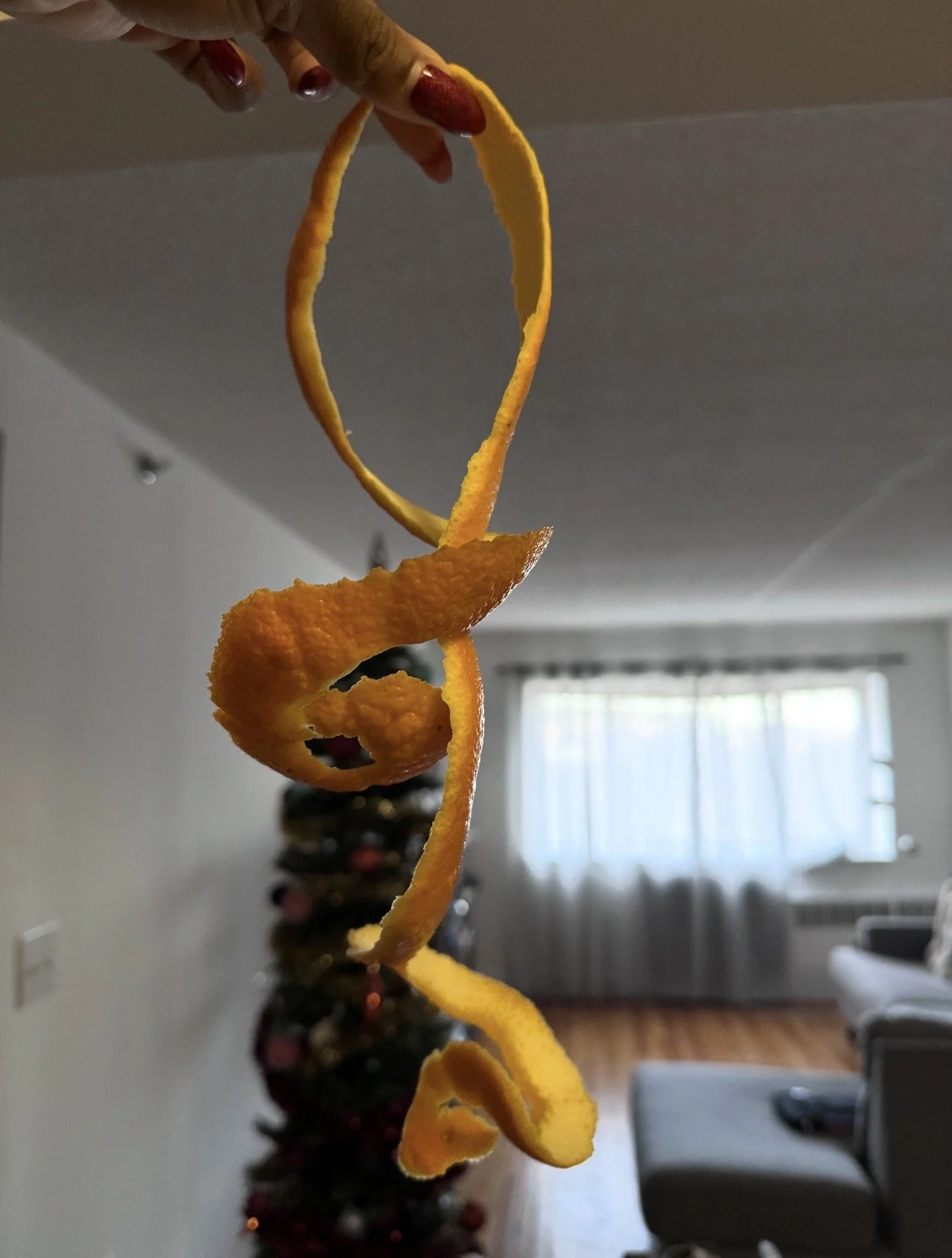
If you are Jamaican, or from another Caribbean culture, you already know the method. You cut the peel in a circle from top to bottom, slow and steady, careful not to break the skin.
I finished peeling the orange, ready to eat it, and suddenly there was excitement.
“You peel di orange and the skin nuh bruk?! You soon married.”
I paused. What was I feeling? I was feeling confused, amused and suspicious.
Of all the proverbs I have heard growing up, this one was brand new. And I have been peeling oranges this way my entire life! I asked my mom if this was actually a real proverb or just something made up. She said yes, it was real. Then we hung up the orange peel to dry. Waste nothing, we can use it to make tea.
I could not help but wonder: Is this just coincidence?
How many oranges have I peeled before and no one said a word?
Is this really a sign?
I have also been talking lately about closing my heart. About protecting my peace. About stepping back from romantic hopefulness and being more guarded, more intentional, more selective with my energy. So part of me wondered if this was less about fate and more about reassurance. Maybe it was an attempt to keep me open, soft, and optimistic. Families do that sometimes. Culture does that often.
I find it really interesting, the stories we tell ourselves when we do not have enough information.
From a therapeutic lens, this moment made me smile. As humans, we are meaning-makers. When love feels uncertain or delayed, we reach for meaning. We look for symbols, signs, and small moments that can ground us. Proverbs, rituals, superstitions, even offhand comments become containers for hope. They give shape to something that otherwise feels unknowable. They do not necessarily predict the future, but they help us tolerate not knowing it.
And then life goes on.
You eat the orange.
You laugh.
The peel dries.
Romance is beautiful. But is it the end-all, be-all? For women, society often answers that question for us: yes. We are told, explicitly and subtly, that love is the achievement, the destination, the proof. That everything else is just the waiting room. Your single era and its lessons are preparation; being chosen by a partner signals you are now complete and off the market. Being chosen and off the market makes it worth the trouble and pain of navigating dating. It all pays off, eventually, they say.
We carry quiet questions about love:
Am I behind?
Am I doing something wrong?
Why does this seem easier and effortless for everyone else?
These questions do not mean you are ungrateful or broken. They mean you are human.
I reflected on my own super-single era of solo dates, solo travel, journaling, manifesting, imagining what love might look like if it came. Wondering whether it would arrive, whether it was “in the cards” for me, whether I was open enough or too guarded/serious, healed enough, or asking for too much. When would it come? Am I doing this right? Where is true love going to find me? And with who?
So many stories of love and hopefulness also involve mirrors. Mirrors invite us to look. We look in them to assess desirability. We play with visualization to imagine ourselves in a future state: partnered, seen, secure. We use them to measure attraction, worth, and readiness. But mirrors can be tricky. They show us an image, not the full story. Mirrors can encourage us to engage in comparison, self-critique, leading to the belief that love depends on how we appear rather than how we connect.
With therapy-seekers, I often talk about the difference between reassurance and grounding.
Reassurance says, “Don’t worry, it’s coming.”
Grounding says, “You are already here, already whole, even while wanting more.”
Reassurance can feel comforting, but also frustrating when you have been patient for a long time. Grounding is harder because it does not promise an outcome. It asks you to stay present without guarantees or trying to control or predict an outcome. Simply put: be married to nothing. In therapy, we talk often about external validation versus internal grounding. How easy it is to outsource reassurance to signs, timelines, or symbols because sitting with uncertainty is uncomfortable. “It’s coming” can sound comforting, but it can also feel dismissive when you are doing real work on yourself and still waiting.
So, could an orange peel or a mirror have the answer? Maybe the orange peel was not a prediction. Maybe it was a reminder: to slow down, to tend carefully, to trust the process without forcing meaning onto every moment, person, connection or relationship. To keep building. To tend to your life, your joy, your success whether love arrives soon, later, or differently than imagined. That kind of reassurance is harder to accept because it does not give a date or a guarantee. It asks for trust without proof.
That kind of wisdom does not rush you.
It does not shame you for wanting more.
It does not tell you to stop hoping, or to base your worth on hope alone.
Maybe the orange peel was not a promise? More likely, it was an invite to pause. It was a funny, tender, very real moment. One that held culture, humor, longing, and reassurance all at once. Perhaps that is what love often looks like. It is not a clear sign, not a perfect reflection, but something that shows up in small, ordinary ways while you are busy living.
And maybe that is the point. Not every symbol needs to be solved. Not every reflection needs an answer. Sometimes wisdom shows up, makes you smile, and lets you keep living.
Orange peeled.
Mirror optional.
Keep on living.
Disclaimer:
The intention for using social media for social workers and other mental health professionals is for marketing, education, advocacy, thought leadership, and providing content in a technologically changing field. We want to do this while making potential therapy-seekers aware of the risks and benefits of engagement on social media and Internet where mental health professionals are present. A therapeutic relationship is a professional relationship and in today's technological climate, a social media presence or following your therapist on social media is not to be confused with a relationship outside of therapy. Ethical, professional, and therapeutic boundaries must be followed and honored.
A counseling social media page or blog is not psychotherapy, a replacement for a therapeutic relationship, or substitute for mental health and medical care. A social media presence as a counseling professional is not seeking an endorsement, request, or rating from past or current clients. No social media posts or blog should be considered professional advice. The information contained in posts is general information for educational purposes only.
Be mindful of sharing personal details or details or others if you choose to comment.
Please consult your physician or mental health provider regarding advice or support for your health and wellbeing.
If you or someone you know is experiencing a medical and/or psychiatric mental health crisis and requires assistance, please call 911 emergency services and/or go to your nearest emergency room (ED) department.
988- National Suicide Prevention Hotline (24 hours a day, 7 days a week)
Safe Horizon 24-hour Hotlines (se habla español):
Domestic violence victims: 800-621-HOPE (4673)